
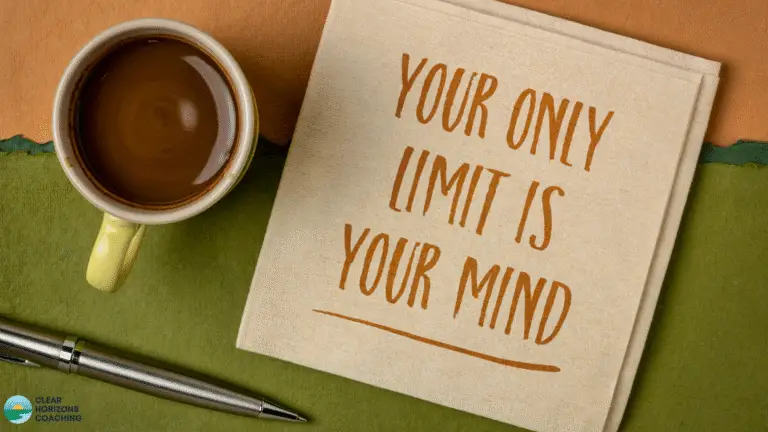
In my last blog post I wrote about how I started to ‘unstick’ myself by asking myself some simple questions about the situation I felt stuck in. In this blog I’m going to take you further on that journey of understanding and change by exploring what we mean by Limiting Beliefs and by giving you 3 easy ways to start changing yours.
The key question I asked myself last time was
What’s stopping me from changing this situation?
And the answers I focused on were the ones that gave an ‘internal’ reason, something I felt about myself. These were my Limiting Beliefs about me.
Did you write down your Limiting Beliefs? If you haven’t already, take a couple of minutes to jot down the first ones that spring to mind before we dive in.
So what are Limiting Beliefs?
Limiting Beliefs are any belief you hold about yourself that is holding you back or preventing you from doing something you want to do. They can be anything at all but some common examples of Limiting Beliefs are: “I’m no good at presentations”, “I’m rubbish in interviews”, “I don’t deserve success” or “I’m not good enough”. They are the words that your inner critic says to you when you are lying awake in the night worrying about that big meeting tomorrow, or when you think about applying for that promotion you would love to get. They creep into your mind, unbidden and unwanted but insidious and powerful.
Where do they come from?
We may be unaware where these beliefs come from but often if we think about it we can remember experiences in our past that have caused them. For example, if you think “I am no good at presentations” you may be able to remember a time in school when you were asked to talk in front of a class and you just clammed up; a seminar in university where you had to present back your findings on a topic & one student laughed at you; and a presentation in work when your boss gave you negative feedback about how it had gone. These negative experiences have layered over each other in your unconscious mind to create a very generalised belief that “I’m no good at presentations”.
So what’s the problem with that? Isn’t it true?
It could be argued that if you’ve had all these negative experiences then you ARE no good at presentations. But there are 3 big problems about Limiting Beliefs:
1) They are GENERALISATIONS that you think are universal
2) They affect your PERCEPTION of reality
3) You act as if they are TRUE, even when they’re NOT TRUE
Let’s dig into each of those in turn.
They are generalisations that you think are universal
This means that you have had a few negative experiences and taken a learning from them which you’ve then applied to all other similar situations. In the example above you’ve taken the poor experiences of presenting and drawn the conclusion that this means you are ALWAYS bad at presenting, even though there might have been other reasons why those particular experiences didn’t go very well (you might have been new to the class, or feeling unwell). You have created this new belief and made it universal – applying it to every future situation.
They affect your perception of reality.
Woah! That’s quite a statement. Limiting Beliefs can affect how you see, hear and feel what’s going on around you? Yes they can. Let me show you.
Wherever you are sitting reading this, take 2 minutes to look around and count everything you can see that is brown.
Have you done that?
Have you got the number of brown things you can see? Great.
No cheating on this next bit.
Without looking, tell yourself how many green things you saw.
I bet you have no idea.
Now take a look around and see how many green things you can see.
So what’s that all about? Why didn’t you notice all the green things?
Because you were focussed on counting the brown things.
Your brain is constantly being bombarded with millions of bits of information. Everything about your environment (not just sights, but sounds, smells, air temperature, wind speed, wind direction, movements; the whole of your internal physiology such as how hungry or thirsty you are) is being processed by your brain whether you are aware of it or not. And that’s the key bit – awareness. To avoid overwhelming your conscious mind, your unconscious mind filters out the things it doesn’t think you need to pay any attention to (in this case the green things), and presents only the things it thinks you need to focus on (the brown things).
So what you focus on is what you see, hear & feel.
So if you are focused on (believe) you are no good at presentations, what do you notice when you are presenting? Do you notice the people in the room who are smiling and nodding? Or the people who are looking glazed or at their phones? What is the reality you think you are seeing? Or hearing? When your boss gave you negative feedback about that presentation did you hear anything from anyone else? Or did you filter anything positive out?
The important thing to remember is that you aren’t doing this consciously. You aren’t seeing someone smiling when you present and consciously thinking “I’ll ignore them” or hearing some positive feedback and thinking “I’ll forget that”. It’s simply your unconscious mind doing what it is programmed to do and filtering out the things it thinks you don’t want / need to pay attention to.
And now for the last of those problematic statements about Limiting Beliefs.
You act as if they are TRUE, even when they are UNTRUE.
As I’ve shown you already, once you have a belief embedded in your mind you start to distort reality in a way that affects all of your experiences and, crucially, reinforces that belief. The more you believe it the more you act in a way that supports that belief. The more strongly you believe you are no good at presentations the more you will go out of your way to avoid them; the more nervous you will be when you do have to do them; and the more harshly you will judge yourself afterwards. If you do happen to have one that goes well, you will tell yourself it was just luck, or that the audience were being kind. You won’t take that positive experience and use it to challenge your belief, you’ll just treat it as a one-off and the belief will stay strong. It really is a lose-lose situation.
What‘s the true cost of Limiting Beliefs?
It may be a surprise, but sometimes your Limiting Beliefs can be a bit of a comfort zone. If you tell yourself you’re no good at presenting you don’t have to do it. If you start the journey of change you’re going to have to put yourself out there and start learning what you can do to improve….and then doing it. The fear of failure can be a powerful force holding you back, keeping you stuck in the same place. Is it even worth it to try and make the change? Only you can know that, and the way to tell is by working out what it costs you.
What do I mean by costs? Well here are some examples. Are there jobs you didn’t apply for because you were too scared of having to do a presentation in the interview? You might have missed out on your dream job and a big pay rise. Have you watched others with less knowledge than you stand up and present on a topic you know inside out? How did that make you feel? Or have you spent hours stressed out because of an upcoming presentation you had to do?
The costs can be financial, mental, emotional and even physical if you are living with high levels of stress and anxiety. Not only that but when you think about what they have cost you in the past AND what they might cost you in the future it really starts to add up.
What is it worth to you to rid yourself of these Limiting Beliefs that cost you so much?
So now you know just how powerful Limiting Beliefs can be AND what they are really costing you. But what on earth can you do about them? The good news is that once you are aware of them you can start working on getting rid of them right away. Here are a couple of techniques that you can use to change your mindset when it comes to Limiting Beliefs.
Challenge the evidence
As we explored earlier, a Limiting Belief comes from specific experiences but our unconscious mind draws a universal conclusion from them and applies that to ALL other events and future experiences, creating a powerful and seemingly impenetrable generalisation. But there is a really simple question that you can use to start chipping away at that belief.
Rather than asking yourself
“Is this true?”
to which the answer will always be Yes when you have that Limiting Belief, ask yourself
“Is this ALWAYS true?”
and really examine your memories or other experiences to see if it is.
For example, if you hold the belief that you’re not confident, ask yourself
“Am I always not confident” or “Is there any example I can think of when I am confident?”.
You will almost certainly be able to think of times you have been confident such as in previous roles, or in things you do outside of work with your family, friends, groups or interests.
Or if you believe that you are no good at presentations, go and ask others for feedback. You may be surprised by what you hear once you remove those belief filters!
Be a Time Lord!
Your Limiting Beliefs are affecting you NOW, even if they are formed from things that happened years ago. And as we’ve also seen they impact you in the future because of how you distort your reality to fit the belief you are unconsciously focused on. But you can use the power of time travel to undermine them and create the possibility of a different future. Sounds exciting doesn’t it? And best of all it’s incredibly easy (no TARDIS or Bill & Ted phone booth required here!). So how do you do it? There are 2 things you need to do to make this work. And they focus on the language you use, because how you talk to yourself matters – we’ve already talked about the power of the inner critic.
Firstly, change your language to send your belief to the past.
Instead of saying “I am” as in “I am no good at presentations” change the words you say to “I have been”, “I was” or “I used to be”.
Try saying one of your Limiting Beliefs out loud right now using this wording:
“I used to be [your Limiting Belief]”.
Sounds different already doesn’t it? You probably feel a bit detached from it, as if it is slightly losing its power over you. And maybe you can get a sense of how proud you are feeling at the fact that you have overcome this belief and improved [your Limiting Belief]. Maybe you are even wondering how you went about doing that?
Putting your Limiting Belief into the past tense is sending a message to your unconscious mind that things are going to be different now.
Now to change your future. This one is even easier.
Just add the word YET.
Instead of saying “I’m no good at presentations” say
“I’m no good at presentations YET”
You try it.
Say “I’m [Limiting Belief] YET”
Make sure you say it with conviction and determination. Say it again
“I’m [Limiting Belief] YET”
How does that feel? Does it sound good? Do you like what you see when you think about your future now?
How on earth is one little word so powerful?
The power of possibility
The power of that one little word lies in the fact that it represents possibilities that you haven’t previously considered. In holding the Limiting Belief that “I’m no good at presentations” you have been ruling out any possibility that you can improve your presentations, that you can change the way you think, feel and act and get a different outcome. It’s not a magic word that miraculously makes you an incredible presenter, you’ve still got some work to do but the thing that stopped you doing that work has gone. The word YET blows that barrier away and opens the door to opportunities and exploration. When you start saying YET you are opening yourself up to exploring how you could get better at presentations. What is it you think you need to work on? Who can help you with that? How can you practice these skills? You’ve set yourself on a path to work on it, changing your future. All from one little word – YET.
The start of something big
So there you are. You now know what your Limiting Beliefs are costing you and have some straightforward tips and techniques to help you start loosening their grip on your life. It will take work, you are changing the “rules” your unconscious mind has been using for a long time to filter your reality, and the unconscious mind is a powerful thing. It’s like a super-computer compared to the conscious mind which is more like a laptop. Changing the way you think and feel about yourself, and consequently the way you act can take time (although in NLP we do have some really effective techniques which can speed things up). Some people find they value the support of a coach, others are happy to go it alone, but whichever path you choose you will never regret leaving those Limiting Beliefs in the past and being able to say
“I remember when I used to believe that [Limiting Belief]”
That sounds good, doesn’t it?